
.svg)


Australia's end-of-life lithium battery supply chain: new guidance strengthens safety
Statements
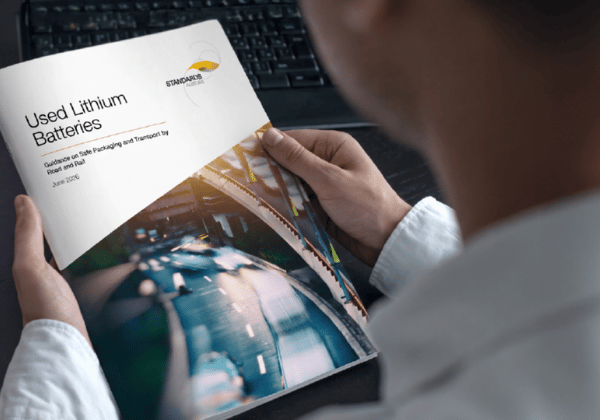
Standards Australia has published a free, practical guide to support organisations involved in the packaging and land transport of used lithium batteries for recycling. It provides nationally consistent guidance on the safe packaging and land transport of used lithium batteries across Australian road and rail networks, for commercial organisations involved in collecting, storing, packaging and transporting used lithium batteries for recycling, reuse and repair.
Used Lithium Batteries: Guidance on Safe Packaging and Transport by Road and Rail was developed in partnership with the Association for the Battery Recycling Industry (ABRI) and Powering Australia, with input from a broad expert advisory group spanning battery recyclers, dangerous goods regulators, fire and emergency services and environmental regulators.
The guide arrives at a critical moment. Australia now records more than 10,000 lithium battery-related fires each year, a figure that will only grow as the country's battery adoption accelerates.
Currently one in five new cars sold in Australia is electric and more than 400,000 homes installed battery storage systems in the past twelve months alone. In 2025, Australia commissioned more grid-scale battery storage than in the previous eight years combined.
Every one of those batteries, as well as those powering countless other devices, has a finite working life. As volumes in circulation increase, so does the responsibility and risk associated with packaging and transporting them safely at end of life.
Standards Australia’s new guide provides practical information tailored to different operational roles, including collection point operators, logistics coordinators and transport operators. Contributing to safer outcomes for workers, businesses and the environment.
Standards Australia CEO Rod Balding said the safe movement of used batteries was an invaluable part of Australia’s energy transition.
"The pace of Australia's battery transition is extraordinary. But a transition of this scale only delivers on its promise if the full lifecycle is managed safely and that includes what happens to a battery when it reaches end of life,” he said.
"This guide is about ensuring the people who handle used batteries can access practical information to do their jobs safely and with confidence. It’s a free, easy-to-use resource and I encourage everyone involved in the collection, transport or recycling of used batteries to download it, share it with their teams and incorporate it into their operations.”
ABRI CEO Katharine Hole said the guide would provide real benefit to the recycling industry.
“The new guidance gives everyone involved in collecting, moving and recycling batteries a clear set of practical steps to follow so batteries can be handled safely and meet compliance needs. Some leading companies are already doing this, but as more batteries enter the system and more businesses become responsible for managing them, it is really important that the whole supply chain has a strong, shared approach in place,” she said.
Powering Australia CEO Shannon O'Rourke said the guide was an important step in the energy transition.
"Powering Australia is pleased to have played a role in the development of this guide, together with our partner ABRI and Standards Australia in response to a growing need."
How you can access Used Lithium Batteries: Guidance on Safe Packaging and Transport by Road and Rail
The guide is available free of charge in digital format, making nationally developed guidance more accessible and supporting greater industry uptake and innovation.
Standards Australia has published a free, practical guide to support organisations involved in the packaging and land transport of used lithium batteries for recycling. It provides nationally consistent guidance on the safe packaging and land transport of used lithium batteries across Australian road and rail networks, for commercial organisations involved in collecting, storing, packaging and transporting used lithium batteries for recycling, reuse and repair.
Used Lithium Batteries: Guidance on Safe Packaging and Transport by Road and Rail was developed in partnership with the Association for the Battery Recycling Industry (ABRI) and Powering Australia, with input from a broad expert advisory group spanning battery recyclers, dangerous goods regulators, fire and emergency services and environmental regulators.
The guide arrives at a critical moment. Australia now records more than 10,000 lithium battery-related fires each year, a figure that will only grow as the country's battery adoption accelerates.
Currently one in five new cars sold in Australia is electric and more than 400,000 homes installed battery storage systems in the past twelve months alone. In 2025, Australia commissioned more grid-scale battery storage than in the previous eight years combined.
Every one of those batteries, as well as those powering countless other devices, has a finite working life. As volumes in circulation increase, so does the responsibility and risk associated with packaging and transporting them safely at end of life.
Standards Australia’s new guide provides practical information tailored to different operational roles, including collection point operators, logistics coordinators and transport operators. Contributing to safer outcomes for workers, businesses and the environment.
Standards Australia CEO Rod Balding said the safe movement of used batteries was an invaluable part of Australia’s energy transition.
"The pace of Australia's battery transition is extraordinary. But a transition of this scale only delivers on its promise if the full lifecycle is managed safely and that includes what happens to a battery when it reaches end of life,” he said.
"This guide is about ensuring the people who handle used batteries can access practical information to do their jobs safely and with confidence. It’s a free, easy-to-use resource and I encourage everyone involved in the collection, transport or recycling of used batteries to download it, share it with their teams and incorporate it into their operations.”
ABRI CEO Katharine Hole said the guide would provide real benefit to the recycling industry.
“The new guidance gives everyone involved in collecting, moving and recycling batteries a clear set of practical steps to follow so batteries can be handled safely and meet compliance needs. Some leading companies are already doing this, but as more batteries enter the system and more businesses become responsible for managing them, it is really important that the whole supply chain has a strong, shared approach in place,” she said.
Powering Australia CEO Shannon O'Rourke said the guide was an important step in the energy transition.
"Powering Australia is pleased to have played a role in the development of this guide, together with our partner ABRI and Standards Australia in response to a growing need."
How you can access Used Lithium Batteries: Guidance on Safe Packaging and Transport by Road and Rail
The guide is available free of charge in digital format, making nationally developed guidance more accessible and supporting greater industry uptake and innovation.