
.svg)


Standards Australia welcomes AU$4 million DFAT investment in standards cooperation under the Vuvale Union Treaty
Statements
When technical standards and quality systems are not aligned across borders, trade slows down, infrastructure risks increase and businesses face costly barriers to operations. Standards serve as the invisible safety net beneath our economies, keeping global trade and supply chains functioning seamlessly. Strengthening standards capability across Fiji will help remove compliance friction, protect local communities and create reliable pathways for regional commerce. It helps to deliver less risk, smoother projects and more certainty for businesses across the Pacific.
At the 2026 Fiji-Australia & Australia-Fiji Business Councils Joint Forum in Suva, Australian High Commissioner to Fiji Peter Roberts OAM announced AU$4 million in funding from the Department of Foreign Affairs and Trade (DFAT) under the Australia-Fiji Vuvale Union Treaty. This initiative marks a major economic cooperation milestone, designed to elevate technical capability and standards infrastructure throughout the region.
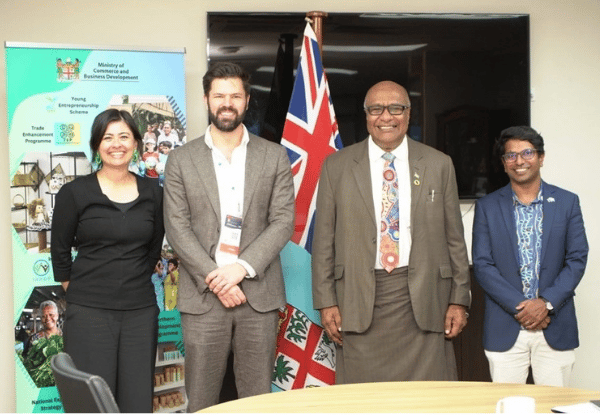
The investment is intended to turn Fiji’s standards policy plan into practical capability by funding advisory support models to co-develop Fiji's National Standardisation Framework. Following priority discussions in Suva between Fijian Deputy Prime Minister Manoa Kamikamica and Standards Australia’s Head of International Strategy, Partnerships and Impact Kamala Truelove and Head of International Jesse Riddell, several potential priority focuses were identified: climate-resilient construction, digital transformation and artificial intelligence, electric vehicles, testing capability and export growth.
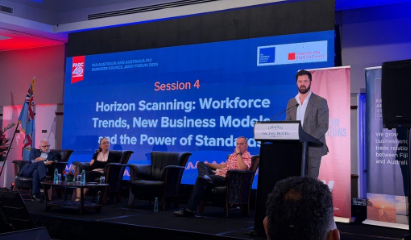
At the Business Councils’ Joint Forum, Jesse Riddell also participated in a panel discussion on Workforce Trends, New Business Models and the Power of Standards. The panel highlighted that technical standards are not just compliance requirements; they are active enablers of innovation, productivity and fair competition across government, regulators and industry.
Standards Australia looks forward to continuing discussions with Fijian counterparts on opportunities to strengthen standards capabilities and build lasting local capacity. Rather than imposing rules created by either nation, this collaborative approach ensures our shared Pacific perspective shapes international standards, we define the competitive conditions for all international market contributors by consensus, and Fiji and Australia support the region’s active involvement in the global standards that govern our shared economic future.
Beyond the technical initiatives, these standards act as economic infrastructure, crafted through consensus. Robust standards move markets, boost productivity and reduce the risk that comes with investment. Increased investment in standards and quality infrastructure under the Vuvale Union Treaty has the potential to strengthen trade resilience, support local enterprises and contribute to sustainable economic growth across the Pacific.
When technical standards and quality systems are not aligned across borders, trade slows down, infrastructure risks increase and businesses face costly barriers to operations. Standards serve as the invisible safety net beneath our economies, keeping global trade and supply chains functioning seamlessly. Strengthening standards capability across Fiji will help remove compliance friction, protect local communities and create reliable pathways for regional commerce. It helps to deliver less risk, smoother projects and more certainty for businesses across the Pacific.
At the 2026 Fiji-Australia & Australia-Fiji Business Councils Joint Forum in Suva, Australian High Commissioner to Fiji Peter Roberts OAM announced AU$4 million in funding from the Department of Foreign Affairs and Trade (DFAT) under the Australia-Fiji Vuvale Union Treaty. This initiative marks a major economic cooperation milestone, designed to elevate technical capability and standards infrastructure throughout the region.
The investment is intended to turn Fiji’s standards policy plan into practical capability by funding advisory support models to co-develop Fiji's National Standardisation Framework. Following priority discussions in Suva between Fijian Deputy Prime Minister Manoa Kamikamica and Standards Australia’s Head of International Strategy, Partnerships and Impact Kamala Truelove and Head of International Jesse Riddell, several potential priority focuses were identified: climate-resilient construction, digital transformation and artificial intelligence, electric vehicles, testing capability and export growth.
At the Business Councils’ Joint Forum, Jesse Riddell also participated in a panel discussion on Workforce Trends, New Business Models and the Power of Standards. The panel highlighted that technical standards are not just compliance requirements; they are active enablers of innovation, productivity and fair competition across government, regulators and industry.
Standards Australia looks forward to continuing discussions with Fijian counterparts on opportunities to strengthen standards capabilities and build lasting local capacity. Rather than imposing rules created by either nation, this collaborative approach ensures our shared Pacific perspective shapes international standards, we define the competitive conditions for all international market contributors by consensus, and Fiji and Australia support the region’s active involvement in the global standards that govern our shared economic future.
Beyond the technical initiatives, these standards act as economic infrastructure, crafted through consensus. Robust standards move markets, boost productivity and reduce the risk that comes with investment. Increased investment in standards and quality infrastructure under the Vuvale Union Treaty has the potential to strengthen trade resilience, support local enterprises and contribute to sustainable economic growth across the Pacific.