
.svg)


Standards Australia Year in Review: Driving confidence in a changing world
Statements
As 2025 draws to a close, Standards Australia reflects on a year of transformation, collaboration, and progress made possible by the dedication of our members, contributors, and partners. This year’s Annual Review for FY24–25 captures the achievements that reinforce our enduring purpose of enabling the safe and sustainable progress of Australian communities.
These achievements were at the heart of discussions during our Annual General Meeting and Members Forum, where members explored how standards underpin resilience, sustainability, and innovation in an era of rapid technological and climate change. Together, these events and this review tell the story of the vital role of standards in building confidence and shaping Australia’s future.
A Year of Impact
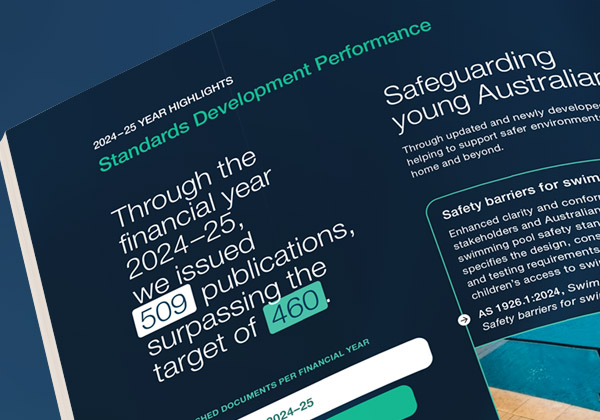
Over the last financial year, Standards Australia published 509 Australian Standards, the highest number in over two decades, which is a testament to the dedication of thousands of technical experts across industry, government, and academia that contribute to our development process. These standards underpin critical sectors, from clean energy infrastructure and circular battery economies to responsible AI and quantum technologies.
Through active representation at ISO and IEC, Australia enhanced our participation in the shaping of international standards, ensuring global interoperability and competitiveness. Sustainability remained a priority, with standards roadmaps for electric vehicle charging infrastructure and battery reuse and recycling, supporting Australia’s transition to a net zero economy.
Annual General Meeting 2025
The 2025 Annual General Meeting was a chance to reflect on a year defined by rapid change and shared progress. Conversations explored the pace of technological change, evolving policy frameworks, and geopolitical volatility that are all reshaping both national and global landscapes. In this context, our vision, to be the trusted voice that provides confidence in an ever-changing world, has never been more vital. The discussions focused on resilience, sustainability, and the role of standards in addressing emerging challenges, from digital transformation to climate transition.
Members Forum: Standards in a Sustainable World
Our Members Forum further explored the theme of Standards in a Sustainable World. Emphasising the role of standards in building trust, driving innovation, and enabling Australia’s transition to net zero. These frameworks are the foundation for progress across energy, recycling, construction, the circular economy and emerging technologies.
Senator Andrew McLachlan CSC addressed the forum as keynote speaker and explored how policy and standards can work together to deliver real change. As a long-standing advocate for environmental stewardship, Senator McLachlan called for placing nature at the centre of decision-making and accelerating the shift to a circular economy. His remarks reinforced the importance of standards in reducing waste, strengthening product stewardship, and fostering innovation that regenerates rather than depletes natural resources.
Panel Session: Shaping Standards for a Sustainable, Net Zero World
Our Members Forum was also joined by a dynamic panel of industry leaders:
- Suzanne Toumbourou, CEO, Australian Council of Recycling
- Kurt Winter, Director Corporate Transition, Carbon Market Institute
- Cathy Inglis AM, CEO, Think Brick Group
- Andrew McLachlan CSC, Senator for South Australia
Moderated by our Chair Tracey Gramlick, the panel examined challenges and opportunities in aligning innovation, industry, and standards to create a credible, sustainable future. Key insights included the need for harmonised technical frameworks to accelerate renewable energy adoption, resource recovery, and carbon management. Panellists highlighted standards as critical enablers of Australia’s climate ambitions, providing the interoperability and trust required for large-scale transformation.
Launching the FY26–30 Strategy: FIT for the Future
Earlier this year, Standards Australia launched its FY26–30 Strategy: FIT for the Future, setting a clear course for the next five years. Built on three strategic pillars of Financial Responsibility, Impact, and Trust, the strategy positions the organisation to navigate technological disruption, climate transition, and global competition through:
- Financial Responsibility: Ensuring long-term sustainability through smarter operations, diversified revenue streams, and strategic investment.
- Impact: Amplifying the role of standards in supporting safety, sustainability, and competitiveness across society and industry.
- Trust: Reinforcing transparency, accountability, and innovation to maintain confidence in governance and services.
Underpinned by enablers such as our People and Digital Solutions, the strategy embraces reinvention and simplification to deliver greater value to members and stakeholders. It also commits to expanding standards development into emerging areas, leveraging digital tools and AI, as well as strengthening international collaboration.
Looking Ahead
As we move into 2026, Standards Australia is focused on shaping the future by driving innovation and resilience in an era where technological transformation and climate priorities are redefining our national landscape. We are committed to advancing these critical conversations and strengthening collaborative partnerships, guided by a strategy that anticipates emerging challenges and opportunities.
Dive deeper into our achievements, insights, and future priorities by reading the complete report.
As 2025 draws to a close, Standards Australia reflects on a year of transformation, collaboration, and progress made possible by the dedication of our members, contributors, and partners. This year’s Annual Review for FY24–25 captures the achievements that reinforce our enduring purpose of enabling the safe and sustainable progress of Australian communities.
These achievements were at the heart of discussions during our Annual General Meeting and Members Forum, where members explored how standards underpin resilience, sustainability, and innovation in an era of rapid technological and climate change. Together, these events and this review tell the story of the vital role of standards in building confidence and shaping Australia’s future.
A Year of Impact
Over the last financial year, Standards Australia published 509 Australian Standards, the highest number in over two decades, which is a testament to the dedication of thousands of technical experts across industry, government, and academia that contribute to our development process. These standards underpin critical sectors, from clean energy infrastructure and circular battery economies to responsible AI and quantum technologies.
Through active representation at ISO and IEC, Australia enhanced our participation in the shaping of international standards, ensuring global interoperability and competitiveness. Sustainability remained a priority, with standards roadmaps for electric vehicle charging infrastructure and battery reuse and recycling, supporting Australia’s transition to a net zero economy.
Annual General Meeting 2025
The 2025 Annual General Meeting was a chance to reflect on a year defined by rapid change and shared progress. Conversations explored the pace of technological change, evolving policy frameworks, and geopolitical volatility that are all reshaping both national and global landscapes. In this context, our vision, to be the trusted voice that provides confidence in an ever-changing world, has never been more vital. The discussions focused on resilience, sustainability, and the role of standards in addressing emerging challenges, from digital transformation to climate transition.
Members Forum: Standards in a Sustainable World
Our Members Forum further explored the theme of Standards in a Sustainable World. Emphasising the role of standards in building trust, driving innovation, and enabling Australia’s transition to net zero. These frameworks are the foundation for progress across energy, recycling, construction, the circular economy and emerging technologies.
Senator Andrew McLachlan CSC addressed the forum as keynote speaker and explored how policy and standards can work together to deliver real change. As a long-standing advocate for environmental stewardship, Senator McLachlan called for placing nature at the centre of decision-making and accelerating the shift to a circular economy. His remarks reinforced the importance of standards in reducing waste, strengthening product stewardship, and fostering innovation that regenerates rather than depletes natural resources.
Panel Session: Shaping Standards for a Sustainable, Net Zero World
Our Members Forum was also joined by a dynamic panel of industry leaders:
- Suzanne Toumbourou, CEO, Australian Council of Recycling
- Kurt Winter, Director Corporate Transition, Carbon Market Institute
- Cathy Inglis AM, CEO, Think Brick Group
- Andrew McLachlan CSC, Senator for South Australia
Moderated by our Chair Tracey Gramlick, the panel examined challenges and opportunities in aligning innovation, industry, and standards to create a credible, sustainable future. Key insights included the need for harmonised technical frameworks to accelerate renewable energy adoption, resource recovery, and carbon management. Panellists highlighted standards as critical enablers of Australia’s climate ambitions, providing the interoperability and trust required for large-scale transformation.
Launching the FY26–30 Strategy: FIT for the Future
Earlier this year, Standards Australia launched its FY26–30 Strategy: FIT for the Future, setting a clear course for the next five years. Built on three strategic pillars of Financial Responsibility, Impact, and Trust, the strategy positions the organisation to navigate technological disruption, climate transition, and global competition through:
- Financial Responsibility: Ensuring long-term sustainability through smarter operations, diversified revenue streams, and strategic investment.
- Impact: Amplifying the role of standards in supporting safety, sustainability, and competitiveness across society and industry.
- Trust: Reinforcing transparency, accountability, and innovation to maintain confidence in governance and services.
Underpinned by enablers such as our People and Digital Solutions, the strategy embraces reinvention and simplification to deliver greater value to members and stakeholders. It also commits to expanding standards development into emerging areas, leveraging digital tools and AI, as well as strengthening international collaboration.
Looking Ahead
As we move into 2026, Standards Australia is focused on shaping the future by driving innovation and resilience in an era where technological transformation and climate priorities are redefining our national landscape. We are committed to advancing these critical conversations and strengthening collaborative partnerships, guided by a strategy that anticipates emerging challenges and opportunities.
Dive deeper into our achievements, insights, and future priorities by reading the complete report.