
.svg)


Standards: Critical infrastructure for Australia’s sustainable future
Statements
Australia’s sustainability transition is being reshaped by global uncertainty, heightened climate impacts and rapid economic transformation. In this environment, the challenge is not only setting ambition, but creating the conditions that enable confidence, consistency and momentum.
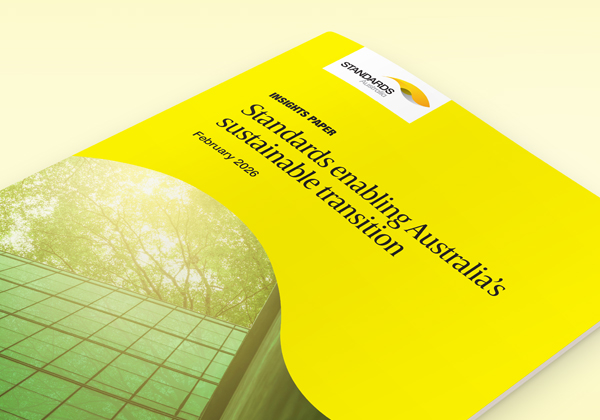
Standards Australia’s latest insights paper, Standards enabling Australia’s sustainable transition, launched following the Standards in a Sustainable World Forum (the forum), examines how standards are supporting this shift from policy intent to real‑world outcomes, providing the foundations for credible action across carbon markets, recycling systems and the built environment.
“The challenge now is delivery, converting ambition into consistent, credible action at scale. Standards play a critical yet often unseen role in this transition. They provide the shared language, benchmarks and assurance that allow innovation, markets and regulation to operate together with confidence,” said Standards Australia CEO Rod Balding.
A world demanding credibility, speed and trust
Globally, governments are tightening climate targets, supply chains are being reshaped by geopolitical shocks, and scrutiny of sustainability claims has intensified. From carbon markets to green building materials, organisations are under mounting pressure to prove not just intent, but impact.
Standards are increasingly central to this credibility challenge, providing agreed definitions, performance benchmarks and assurance frameworks that underpin trust in data, markets and emerging technologies.
In Australia, this need is sharpened by the move from policy design to implementation. With legislated emissions targets, a reformed Safeguard Mechanism and expanding carbon and recycling markets, attention is turning to the practical question: how do we measure, compare and scale action consistently?
This is where standards matter most, acting as the bridge between policy ambition and real‑world delivery.
As Senator Andrew McLachlan CSC noted during the forum, “Government and the public need to understand the importance of standards.”
Six insights shaping the next phase of transition
Drawing on perspectives from parliament, industry and technical experts, the paper identifies six areas where standards can have the greatest impact:
- Standards as essential national infrastructure, enabling interoperability, comparability and confidence across sectors and supply chains
- Greater agility and pace, to keep up with fast‑moving technologies, markets and expectations
- Clearer pathways, helping users navigate an increasingly crowded and complex standards landscape
- Adoption at scale, through stronger alignment with regulation, procurement and incentives
- Performance‑based and circular outcomes, embedding durability, reuse and lifecycle thinking while supporting innovation
- Trust, assurance and integrity, particularly for carbon markets, sustainability claims and data
From carbon markets to the built environment
The paper highlights how standards are already shaping outcomes in key sectors:
- Carbon markets, by improving transparency, comparability and credibility as markets grow in scale and complexity
- Recycling and the circular economy, by supporting circular design and building confidence in recovered materials
- The built environment, where performance‑based standards enable innovation while ensuring safety, durability and long‑term value
It also outlines how Standards Australia is responding through more agile development pathways, including faster standards for emerging materials such as biochar and hempcrete, and international work on environmental data and artificial intelligence governance.
A practical mechanism for a sustainable future
Australia’s sustainability transition will ultimately be defined not by targets, but by execution.
Standards can help provide one of the most effective mechanisms available to align policy intent, market confidence and innovation – supporting durable environmental, economic and social outcomes through 2030 and beyond.
Australia’s sustainability transition is being reshaped by global uncertainty, heightened climate impacts and rapid economic transformation. In this environment, the challenge is not only setting ambition, but creating the conditions that enable confidence, consistency and momentum.
Standards Australia’s latest insights paper, Standards enabling Australia’s sustainable transition, launched following the Standards in a Sustainable World Forum (the forum), examines how standards are supporting this shift from policy intent to real‑world outcomes, providing the foundations for credible action across carbon markets, recycling systems and the built environment.
“The challenge now is delivery, converting ambition into consistent, credible action at scale. Standards play a critical yet often unseen role in this transition. They provide the shared language, benchmarks and assurance that allow innovation, markets and regulation to operate together with confidence,” said Standards Australia CEO Rod Balding.
A world demanding credibility, speed and trust
Globally, governments are tightening climate targets, supply chains are being reshaped by geopolitical shocks, and scrutiny of sustainability claims has intensified. From carbon markets to green building materials, organisations are under mounting pressure to prove not just intent, but impact.
Standards are increasingly central to this credibility challenge, providing agreed definitions, performance benchmarks and assurance frameworks that underpin trust in data, markets and emerging technologies.
In Australia, this need is sharpened by the move from policy design to implementation. With legislated emissions targets, a reformed Safeguard Mechanism and expanding carbon and recycling markets, attention is turning to the practical question: how do we measure, compare and scale action consistently?
This is where standards matter most, acting as the bridge between policy ambition and real‑world delivery.
As Senator Andrew McLachlan CSC noted during the forum, “Government and the public need to understand the importance of standards.”
Six insights shaping the next phase of transition
Drawing on perspectives from parliament, industry and technical experts, the paper identifies six areas where standards can have the greatest impact:
- Standards as essential national infrastructure, enabling interoperability, comparability and confidence across sectors and supply chains
- Greater agility and pace, to keep up with fast‑moving technologies, markets and expectations
- Clearer pathways, helping users navigate an increasingly crowded and complex standards landscape
- Adoption at scale, through stronger alignment with regulation, procurement and incentives
- Performance‑based and circular outcomes, embedding durability, reuse and lifecycle thinking while supporting innovation
- Trust, assurance and integrity, particularly for carbon markets, sustainability claims and data
From carbon markets to the built environment
The paper highlights how standards are already shaping outcomes in key sectors:
- Carbon markets, by improving transparency, comparability and credibility as markets grow in scale and complexity
- Recycling and the circular economy, by supporting circular design and building confidence in recovered materials
- The built environment, where performance‑based standards enable innovation while ensuring safety, durability and long‑term value
It also outlines how Standards Australia is responding through more agile development pathways, including faster standards for emerging materials such as biochar and hempcrete, and international work on environmental data and artificial intelligence governance.
A practical mechanism for a sustainable future
Australia’s sustainability transition will ultimately be defined not by targets, but by execution.
Standards can help provide one of the most effective mechanisms available to align policy intent, market confidence and innovation – supporting durable environmental, economic and social outcomes through 2030 and beyond.