
.svg)


Australia partners with Timor-Leste to strengthen national standards framework in support of ASEAN accession
Statements
Australia continues to play a leading role in strengthening international standards cooperation, with Timor-Leste taking important steps to build its national systems for standards and conformance as it prepares for deeper regional economic integration.
The recent visit by Prime Minister Anthony Albanese to Timor-Leste reaffirmed the strength of the bilateral relationship and Australia’s commitment to supporting Timor-Leste’s economic development. During the visit, the PM announced additional funding for technical assistance to improve quality and reach of essential services, including health, education, and disability support. Standards Australia’s collaboration on standards sits alongside these priorities, helping build the systems needed for regional integration and long-term economic resilience.
This week marked the beginning of phase two of the Timor-Leste Standards Uplift Initiative, delivered by Standards Australia in collaboration with the Institute of Quality of Timor-Leste (IQTL). A Standards Australia delegation travelled to Dili to advance the next stage of the program, focused on building the knowledge, skills, and institutional capability required for a robust and internationally aligned national standards framework.
The initiative supports Timor-Leste’s government, industry, and regulators in adopting global best practice in standardisation – creating foundations for stronger participation in international markets and future regional integration, including commitments associated with ASEAN accession.
Since the release of the Standardisation Roadmap in 2025, the Uplift initiative has helped guide the country’s economic development agenda through enhanced standardisation, improved quality and safety, and strengthened institutional processes. Standards Australia has since supported IQTL’s in the compliance efforts required for Timor-Leste’s progress toward membership of the World Trade Organization and ASEAN. These reforms are helping unlock new export opportunities, streamline imports, and strengthen alignment with regional trading partners.
A key priority for the next phase is supporting the ASEAN accession process, ensuring that national standards align with regional frameworks and enabling Timor-Leste products to compete in the region. To support this, two technical committees have been established; one focused on coffee, Timor-Leste’s most significant agricultural export, and another on electronics to build sector capability, increase competitiveness, and expand access to new markets.
The week also included leadership training, aimed at strengthening institutional capacity across Timor-Leste’s emerging standards ecosystem.
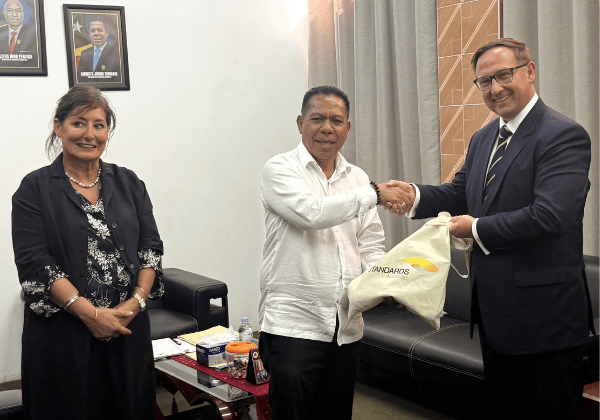
Rod Balding, Standards Australia’s CEO, met with both Augusto Júnior Trindade, Vice Minister of Commerce and Industry, and Jorge Rui de Carvalho Martins, General Coordinator at the Ministry of Coordinating Economic Affairs, and to continue discussions on supporting economic resilience and improving consumer protection.
“This partnership is about building long-term capability,” Rod said. “It demonstrates the impact that strong, trusted standards can have in building economic resilience and supporting nations to participate confidently in global trade.”
His Excellency Vice Minister Augusto Júnior Trindade noted that the collaboration is already helping accelerate national reforms.
“Strong standards infrastructure is a key pillar in Timor-Leste's economic transformation and sustainable growth,” he concluded.
Read more about the Uplift initiative:
Australia continues to play a leading role in strengthening international standards cooperation, with Timor-Leste taking important steps to build its national systems for standards and conformance as it prepares for deeper regional economic integration.
The recent visit by Prime Minister Anthony Albanese to Timor-Leste reaffirmed the strength of the bilateral relationship and Australia’s commitment to supporting Timor-Leste’s economic development. During the visit, the PM announced additional funding for technical assistance to improve quality and reach of essential services, including health, education, and disability support. Standards Australia’s collaboration on standards sits alongside these priorities, helping build the systems needed for regional integration and long-term economic resilience.
This week marked the beginning of phase two of the Timor-Leste Standards Uplift Initiative, delivered by Standards Australia in collaboration with the Institute of Quality of Timor-Leste (IQTL). A Standards Australia delegation travelled to Dili to advance the next stage of the program, focused on building the knowledge, skills, and institutional capability required for a robust and internationally aligned national standards framework.
The initiative supports Timor-Leste’s government, industry, and regulators in adopting global best practice in standardisation – creating foundations for stronger participation in international markets and future regional integration, including commitments associated with ASEAN accession.
Since the release of the Standardisation Roadmap in 2025, the Uplift initiative has helped guide the country’s economic development agenda through enhanced standardisation, improved quality and safety, and strengthened institutional processes. Standards Australia has since supported IQTL’s in the compliance efforts required for Timor-Leste’s progress toward membership of the World Trade Organization and ASEAN. These reforms are helping unlock new export opportunities, streamline imports, and strengthen alignment with regional trading partners.
A key priority for the next phase is supporting the ASEAN accession process, ensuring that national standards align with regional frameworks and enabling Timor-Leste products to compete in the region. To support this, two technical committees have been established; one focused on coffee, Timor-Leste’s most significant agricultural export, and another on electronics to build sector capability, increase competitiveness, and expand access to new markets.
The week also included leadership training, aimed at strengthening institutional capacity across Timor-Leste’s emerging standards ecosystem.
Rod Balding, Standards Australia’s CEO, met with both Augusto Júnior Trindade, Vice Minister of Commerce and Industry, and Jorge Rui de Carvalho Martins, General Coordinator at the Ministry of Coordinating Economic Affairs, and to continue discussions on supporting economic resilience and improving consumer protection.
“This partnership is about building long-term capability,” Rod said. “It demonstrates the impact that strong, trusted standards can have in building economic resilience and supporting nations to participate confidently in global trade.”
His Excellency Vice Minister Augusto Júnior Trindade noted that the collaboration is already helping accelerate national reforms.
“Strong standards infrastructure is a key pillar in Timor-Leste's economic transformation and sustainable growth,” he concluded.
Read more about the Uplift initiative: